

Loft Conversions with Roof Terraces
A loft conversion with a roof terrace can create valuable additional living space and a private outdoor area, but careful planning, structural design and neighbour-sensitive detailing are essential.
A loft conversion with a roof terrace can transform the way a home works.
The loft itself may create a valuable new bedroom, principal suite or home office. The adjoining roof terrace can then provide a private outdoor area with space for seating, planting and views across the surrounding roofscape.
For homeowners living in densely developed parts of London and the Home Counties, this can be particularly attractive.
Many terraced houses, maisonettes and converted properties have limited garden space. Some flats may have no private outdoor area at all.
A carefully designed roof terrace can create:
-
a private seating area;
-
space for morning coffee or evening drinks;
-
a small outdoor dining area;
-
views across gardens and rooftops;
-
additional natural light;
-
better ventilation;
-
a stronger connection between the loft and the outside;
-
an attractive feature for future buyers.
However, a roof terrace should not be treated as a simple addition to a loft conversion.
It raises important questions around planning permission, privacy, overlooking, noise, structural loading, drainage, waterproofing, access, balustrades and neighbour impact.
The strongest schemes begin with a realistic review of what is likely to be acceptable.
What Is a Loft Conversion with a Roof Terrace?
A loft conversion with a roof terrace usually involves creating a new habitable room within the roof and providing direct access to an external terrace area.
The terrace may be formed:
-
above a rear addition;
-
above an existing flat roof;
-
within a recessed section of the loft conversion;
-
behind a parapet wall;
-
behind a mansard roof;
-
beside a rear dormer;
-
above part of a lower extension;
-
within a purpose-designed roof structure.
The terrace may be accessed through:
-
full-height glazed doors;
-
sliding doors;
-
French doors;
-
a glazed opening from a bedroom;
-
a door from a landing;
-
a door from a study or living space.
The design will depend on the property.
In some homes, the roof terrace forms part of a larger mansard or L-shaped loft conversion.
In others, the terrace may sit above an existing rear addition and be reached from a more modest loft room.
Why Homeowners Want Roof Terraces
A roof terrace can provide something that is difficult to create in a typical London home: private outdoor space with light, air and views.
A ground-floor garden may already exist, but the roof terrace can offer a different experience.
It may feel:
-
quieter;
-
more private;
-
brighter;
-
more open;
-
more connected to the sky;
-
more suitable for a bedroom suite;
-
more useful for short periods of relaxation;
-
less overlooked from the street.
For upper-floor flats and maisonettes, the value can be even greater.
A roof terrace may provide the only practical opportunity to create private outdoor space.
The design should still remain proportionate.
A roof terrace should improve the home without causing unreasonable harm to neighbouring properties.
Roof Terrace, Juliet Balcony or False Balcony?
Homeowners sometimes use the terms roof terrace, balcony and Juliet balcony interchangeably, but they are different.
A roof terrace is an external area that can be stepped onto and used as outdoor space.
A balcony is usually a platform projecting from the building or formed as part of the structure.
A Juliet balcony or false balcony normally consists of full-height doors or windows with a protective balustrade immediately outside. It does not provide a platform that can be occupied.
This distinction matters.
A Juliet balcony can bring light, ventilation and a stronger connection with the outdoors without creating an external seating area.
Where a full roof terrace is unlikely to gain planning support, a Juliet balcony may provide a more realistic alternative.
Planning Permission Is Usually Required
A loft conversion with a roof terrace will normally require a full planning application.
A conventional loft conversion may sometimes fall within permitted development rights.
However, a roof terrace, balcony or raised platform introduces a different level of impact.
The planning authority is likely to consider:
-
overlooking;
-
privacy;
-
noise;
-
the effect on neighbouring gardens;
-
the effect on neighbouring windows;
-
the height and position of the terrace;
-
balustrades;
-
screening;
-
the appearance of the roof;
-
the character of the property;
-
the wider roofscape;
-
conservation-area policies;
-
whether the terrace feels overbearing;
-
whether similar roof terraces already exist nearby.
A homeowner should not assume that a roof terrace will be approved simply because the loft conversion itself appears acceptable.
The terrace needs to be assessed on its own merits.
Privacy and Overlooking
Privacy is one of the most important planning considerations.
A roof terrace can create elevated views into neighbouring gardens, bedrooms and living spaces.
This may be much more intrusive than views from an ordinary window.
The planning authority may consider:
-
the distance to neighbouring windows;
-
the angle of overlooking;
-
views into gardens;
-
the size of the terrace;
-
the likely intensity of use;
-
the location of seating;
-
the height of balustrades;
-
the effectiveness of privacy screens;
-
whether screening would create an overbearing structure;
-
whether planting could help soften the design.
A terrace that looks directly into neighbouring gardens may face resistance.
A smaller recessed terrace with carefully positioned screening may be easier to justify.
The most successful designs reduce overlooking from the beginning rather than trying to solve the problem after the layout has been fixed.
Noise and Neighbour Amenity
Noise can also be a concern.
A bedroom window does not create the same type of impact as an external seating area.
A roof terrace may be used for conversations, music, eating, drinking and entertaining.
Even a relatively small terrace can feel intrusive where it sits close to neighbouring bedrooms or gardens.
The design should consider:
-
the size of the terrace;
-
the likely number of users;
-
the position of seating;
-
the relationship with neighbours;
-
access times;
-
acoustic separation;
-
planting;
-
screening;
-
whether the terrace is intended as a modest amenity space or a larger entertaining area.
A small terrace designed for occasional seating may be more acceptable than a large platform capable of hosting groups of people.
The planning application should present a realistic and responsible use of the space.
Recessed Roof Terraces
A recessed roof terrace can sometimes provide a more discreet solution.
Rather than projecting outward from the roof, the terrace is set within the roof form or behind a parapet wall.
This can reduce the visual impact and may help limit overlooking.
A recessed terrace may include:
-
a small seating area;
-
full-height glazed doors;
-
a parapet wall;
-
privacy screens;
-
carefully positioned planters;
-
a discreet balustrade;
-
drainage outlets;
-
lighting;
-
access from a bedroom or study.
The terrace should still be assessed carefully.
A recessed position does not remove the need for planning permission, structural design or waterproofing.
However, it may create a more neighbour-sensitive and architecturally coherent result.
Terraces Above Rear Additions
Traditional terraced houses often have a rear addition or outrigger.
The flat roof above that section may appear to offer an obvious opportunity for a terrace.
This can be particularly attractive where the loft is being converted as part of an L-shaped dormer or mansard scheme.
The terrace may be accessed from:
-
a rear bedroom;
-
a landing;
-
a study;
-
a principal suite;
-
a glazed opening within the loft conversion.
However, the existing flat roof should not be assumed to be suitable for occupation.
A roof designed only to keep out the weather may not have been designed to carry:
-
people;
-
furniture;
-
planters;
-
decking;
-
balustrades;
-
privacy screens;
-
additional structural loads;
-
concentrated loads from posts or supports.
The roof structure should be assessed carefully.
A new structural floor or supporting steelwork may be required.
Small Roof Terraces Can Work Better
A roof terrace does not need to be large to be valuable.
A modest terrace with space for two chairs, a small table and carefully selected planting may provide an attractive outdoor retreat.
A smaller terrace may also be easier to design sensitively.
It may:
-
reduce overlooking;
-
reduce noise;
-
reduce structural loading;
-
sit more comfortably within the roof;
-
require less dominant screening;
-
feel more private;
-
be easier to maintain;
-
have less impact on neighbours.
The objective should not be to create the largest possible platform.
The objective should be to create a practical, attractive and responsible outdoor space.
Balustrades and Safety
A roof terrace will need a suitable protective balustrade.
The design should provide safety without making the terrace feel heavy or visually dominant.
Possible balustrade options include:
-
clear glass;
-
frosted glass;
-
metal railings;
-
traditional steel railings;
-
slim contemporary metalwork;
-
parapet walls;
-
a combination of solid walls and glazing;
-
privacy screens integrated with the balustrade.
The most appropriate approach will depend on:
-
the architecture of the property;
-
the planning context;
-
privacy;
-
views;
-
the height of the terrace;
-
wind exposure;
-
maintenance;
-
the relationship with neighbours;
-
Building Regulations requirements.
A frameless glass balustrade may preserve views, but it may not provide sufficient privacy.
A solid screen may improve privacy, but it can appear overbearing.
A carefully balanced design is needed.
Privacy Screens
Privacy screens can play an important role.
They may help reduce direct views towards neighbouring gardens or windows.
Possible solutions include:
-
obscure glazing;
-
frosted glass;
-
slatted timber-style screens;
-
metal screening;
-
planters;
-
trellis-style screening;
-
parapet walls;
-
angled screens;
-
carefully positioned planting.
However, screens need careful design.
A screen that is too low may not solve the overlooking problem.
A screen that is too high or bulky may create an oppressive structure for neighbours.
The planning authority may assess the screen as part of the terrace proposal.
It should be integrated into the architecture rather than added as an afterthought.
Structural Design Is Essential
A roof terrace introduces different structural demands from a standard loft roof.
The structure may need to support:
-
people;
-
furniture;
-
planters;
-
decking;
-
balustrades;
-
privacy screens;
-
paving;
-
drainage falls;
-
waterproofing layers;
-
snow and wind loads;
-
concentrated loads at posts and junctions.
The structural engineer may need to design:
-
new floor joists;
-
steel beams;
-
structural timber;
-
trimming members;
-
support posts;
-
parapet details;
-
balustrade fixings;
-
load paths;
-
lateral restraint;
-
connections to the existing walls;
-
support above the rear addition;
-
any alterations to the existing roof.
The existing structure should be reviewed carefully.
A flat roof designed as a weatherproof covering should not automatically be treated as a terrace floor.
Waterproofing and Drainage
Waterproofing is one of the most important practical issues.
A roof terrace must keep water out of the rooms below while allowing rainwater to drain safely.
The design should consider:
-
falls;
-
drainage outlets;
-
gutters;
-
downpipes;
-
overflow routes;
-
waterproof membranes;
-
upstands;
-
door thresholds;
-
parapet walls;
-
balustrade fixings;
-
service penetrations;
-
decking supports;
-
maintenance access;
-
leaf debris;
-
blocked outlets;
-
snow and heavy rainfall.
Every fixing through the waterproofing layer creates a potential weak point.
Balustrades, screens and decking should be detailed carefully to reduce the risk of leaks.
The terrace should also be designed so that drainage outlets remain accessible for maintenance.
Poor waterproofing can create expensive problems for both the homeowner and neighbours.
Decking, Paving and Terrace Finishes
The terrace surface needs careful selection.
Possible finishes include:
-
timber decking;
-
composite decking;
-
paving on support pads;
-
porcelain tiles;
-
slip-resistant surfaces;
-
lightweight terrace systems;
-
removable access panels;
-
planted areas;
-
gravel margins.
The finish should be:
-
safe in wet weather;
-
suitable for external use;
-
easy to maintain;
-
compatible with the waterproofing system;
-
reasonably lightweight;
-
properly drained;
-
detailed around door thresholds;
-
removable where access to drainage is needed.
Heavy paving and large planters can add substantial weight.
The structural engineer should consider the full build-up and intended use.
Access and Full-Height Glazing
The terrace is often accessed through full-height glazed doors.
These can bring light into the loft and create a stronger connection with the outside.
Possible options include:
-
French doors;
-
sliding doors;
-
slim-framed glazed doors;
-
inward-opening doors;
-
outward-opening doors where appropriate;
-
a fixed glazed panel beside an opening door;
-
wider contemporary glazing.
The design should consider:
-
safety;
-
thresholds;
-
waterproofing;
-
thermal performance;
-
ventilation;
-
security;
-
views;
-
privacy;
-
furniture positions;
-
overheating;
-
the relationship with the balustrade.
The doors should feel like part of the room design rather than simply an opening onto the terrace.


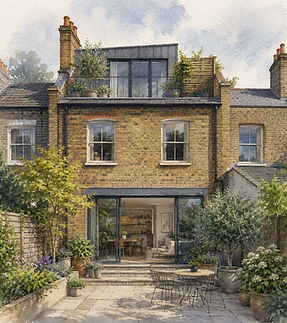

Roof Terraces and Mansard Loft Conversions
A roof terrace may be incorporated into a mansard conversion.
The mansard structure can create a more architectural and integrated arrangement, particularly on London terraced properties.
A recessed terrace may sit behind part of the mansard roof or alongside a dormer.
This may allow the design to:
-
reduce visual impact;
-
improve privacy;
-
create a sheltered seating area;
-
preserve more of the roof form;
-
integrate screening;
-
create full-height glazing;
-
provide a stronger connection with a bedroom suite.
The design needs careful planning.
A roof terrace should not undermine the proportions of the mansard or create an awkward gap within the roof.
Roof Terraces and L-Shaped Loft Conversions
An L-shaped conversion may provide an opportunity to create a terrace above the rear addition.
The main loft floor may contain bedrooms and a landing, while the rear-addition roof provides external space.
This arrangement can work particularly well where:
-
the rear addition has a flat roof;
-
the adjoining properties have similar arrangements;
-
overlooking can be controlled;
-
the terrace remains modest in size;
-
the structure can be upgraded;
-
access is convenient;
-
privacy screens can be integrated sensitively.
The terrace should not simply be added because the flat roof appears unused.
Its effect on neighbours and the wider rear elevation needs careful consideration.
Roof Terraces Above Flats and Maisonettes
A roof terrace may be especially attractive for an upper-floor flat or maisonette.
However, the legal and planning issues can be more complex.
The homeowner may need to consider:
-
ownership of the roof space;
-
the freeholder;
-
the lease;
-
rights of access;
-
structural responsibility;
-
insurance;
-
maintenance obligations;
-
service charges;
-
planning permission;
-
Building Regulations;
-
Party Wall matters;
-
neighbour consultation;
-
fire safety;
-
escape routes;
-
communal areas.
A roof may appear physically accessible but still fall outside the homeowner’s ownership or control.
Legal advice may be needed before substantial design work begins.
Party Wall Matters
A loft conversion with a roof terrace may affect shared walls and neighbouring structures.
Depending on the design, the work may include:
-
inserting steel beams into a party wall;
-
raising a party wall;
-
altering parapets;
-
working close to the boundary;
-
building above a rear addition;
-
changing drainage;
-
weatherproofing junctions;
-
fixing structural supports;
-
altering shared roof details.
These works may fall within the scope of the Party Wall etc. Act 1996.
Where notices are required, they should be served before the relevant work begins.
Party Wall matters should not be left until the contractor is ready to start on site.
Early advice can reduce delay and avoid unnecessary disputes.
Fire Safety and the Protected Escape Route
A loft conversion with a roof terrace will still need to address the fire-safety requirements affecting the new habitable loft floor.
The terrace does not replace the need for a suitable internal escape route.
Where the loft conversion creates a new third storey above an existing two-storey house, the occupants will normally need a protected route down through the house to a final exit at ground-floor level.
The work may include:
-
reviewing walls and ceilings around the staircase;
-
upgrading partitions where necessary;
-
installing suitable fire-resisting doorsets;
-
reviewing door frames, hinges and ironmongery;
-
installing mains-powered interlinked smoke alarms;
-
protecting the new floor structure;
-
reviewing the staircase enclosure;
-
checking the route to the final exit;
-
considering any open-plan ground-floor layout.
The terrace may provide useful external space, but it should not be assumed to function automatically as a compliant fire-escape route.
The correct fire-safety strategy should be agreed through the building-control process.
Open-Plan Ground Floors Need Early Review
Many homes have open-plan kitchens, dining rooms and family spaces at ground-floor level.
This can complicate the fire strategy for a loft conversion.
Where the staircase opens directly into a kitchen or living space rather than leading through a protected hallway to the front door, additional measures may be needed.
These could include:
-
a new fire-resisting partition;
-
a carefully positioned door;
-
enhanced fire detection;
-
sprinkler protection;
-
an alternative fire-safety solution agreed with the building-control body.
This should be reviewed early because it may affect the layout, feasibility and budget.
Building Regulations Approval
A loft conversion with a roof terrace will normally require Building Regulations approval.
The technical drawings and supporting information should address:
-
the new structural floor;
-
terrace loading;
-
steel beams;
-
roof alterations;
-
staircase design;
-
headroom;
-
fire safety;
-
smoke alarms;
-
the protected escape route;
-
waterproofing;
-
drainage;
-
balustrades;
-
guarding;
-
glazing safety;
-
thermal insulation;
-
ventilation;
-
sound insulation;
-
electrical work;
-
access;
-
door thresholds;
-
structural fixings;
-
Party Wall junctions;
-
any bathroom or drainage works.
A structural engineer will often be needed.
Good technical drawings help contractors price the full scope accurately and reduce the risk of expensive design decisions being made during construction.
Conservation Areas and Sensitive Locations
A roof terrace can be particularly sensitive in a conservation area or on a prominent period property.
The planning authority may consider:
-
the visibility of the terrace;
-
balustrades;
-
privacy screens;
-
the roofline;
-
the character of the building;
-
neighbouring terraces;
-
views from the street;
-
rear roofscape views;
-
the visual bulk of the proposal;
-
the materials;
-
whether the terrace harms the character of the area.
A smaller recessed terrace may sometimes be easier to justify than a large exposed platform.
The local context matters.
Similar terraces nearby can be relevant, but they do not guarantee that a new proposal will be approved.
Can a Roof Terrace Add Value?
A carefully designed roof terrace can add appeal and value to a property, particularly where private outdoor space is limited.
The value will depend on:
-
the size of the terrace;
-
the outlook;
-
privacy;
-
sunlight;
-
access;
-
noise;
-
the quality of the design;
-
planning approval;
-
the standard of construction;
-
maintenance requirements;
-
the relationship with the loft room;
-
the local property market.
A private terrace adjoining a principal bedroom or home office can feel particularly attractive.
However, a poorly designed terrace may create maintenance problems, privacy disputes or planning difficulties.
The strongest value comes from a terrace that feels like a natural and responsible part of the home.
How Much Does a Loft Conversion with a Roof Terrace Cost?
A loft conversion with a roof terrace will usually cost more than an equivalent loft conversion without external amenity space.
The additional cost may include:
-
structural strengthening;
-
steel beams;
-
terrace floor construction;
-
waterproofing;
-
drainage;
-
decking or paving;
-
balustrades;
-
privacy screens;
-
full-height doors;
-
glazing;
-
parapet work;
-
Party Wall matters;
-
planning drawings;
-
technical drawings;
-
structural calculations;
-
scaffolding;
-
temporary weather protection;
-
electrical work;
-
lighting;
-
decorating;
-
maintenance access;
-
higher-quality external finishes.
The cost will depend heavily on the existing structure and the complexity of the terrace.
A flat roof should not be assumed to need only decking and railings.
The structural and waterproofing requirements can be substantial.
Choosing the Right Contractor
A roof terrace requires a contractor with relevant experience.
The work combines loft conversion, roofing, structural design, drainage, waterproofing, external finishes and safety detailing.
Before accepting a quotation, check whether it includes:
-
scaffolding;
-
temporary weather protection;
-
structural steelwork;
-
terrace floor construction;
-
waterproofing;
-
drainage outlets;
-
overflow arrangements;
-
balustrades;
-
privacy screens;
-
decking or paving;
-
glazing;
-
doors;
-
roof alterations;
-
staircase work;
-
insulation;
-
plastering;
-
electrical work;
-
lighting;
-
fire-safety upgrades;
-
smoke alarms;
-
decorating;
-
making good;
-
waste removal;
-
building-control coordination;
-
Party Wall-related requirements.
It is also sensible to review:
-
examples of previous roof terraces;
-
references;
-
insurance cover;
-
waterproofing guarantees;
-
the drainage design;
-
the balustrade specification;
-
exclusions;
-
payment stages;
-
responsibility for inspections;
-
variation procedures.
A roof terrace should not be treated as a minor add-on.
The detailing matters.
Start With the Right Advice
A loft conversion with a roof terrace can create a highly attractive combination of indoor and outdoor space.
For the right property, it may provide a bedroom, principal suite or home office with direct access to a private terrace overlooking the surrounding roofscape.
However, the opportunity comes with complexity.
The planning position, privacy, overlooking, noise, structural loading, waterproofing, drainage, balustrades, Party Wall implications, fire safety and Building Regulations requirements all need careful consideration.
The objective should not be to create the largest possible terrace.
The objective should be to create a modest, attractive and properly designed outdoor space that improves the home without causing unreasonable harm to neighbours.
Considering a loft conversion with a roof terrace?
Tell us about your property and the type of space you hope to create. We can help connect you with relevant loft-conversion professionals and specialist support for the next stage of your project.