
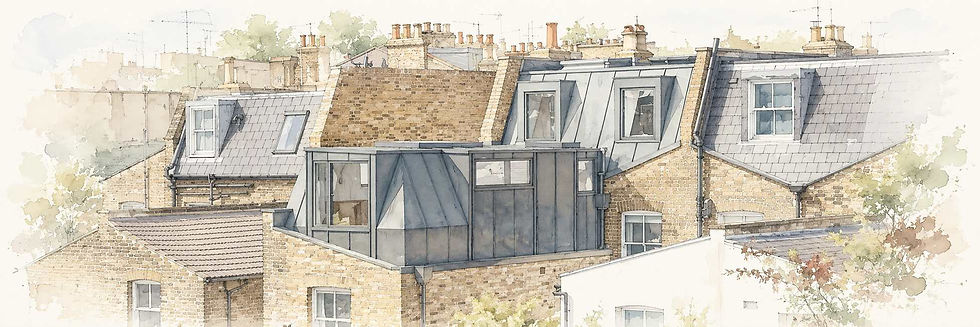
Planning Permission for Mansard Loft Conversions
A mansard loft conversion can create a generous additional floor, but the substantial change to the roof means that a planning application will usually be required.
A mansard loft conversion is one of the most effective ways to unlock the potential of a restricted roof space.
Rather than simply adding a box-shaped dormer to the existing roof slope, a traditional mansard usually involves raising the party walls and constructing a new, steeply sloping roof form between them. Dormer windows are then set into the new slope, with a flatter roof section above.
The result can be a practical and attractive additional floor with far better headroom than a modest dormer conversion.
Mansards are particularly relevant to period terraced properties in London and other urban areas, where the existing roof space may be restricted but neighbouring properties have already established a pattern of roof extensions.
However, a mansard is a substantial alteration.
In most cases, a traditional mansard loft conversion should be approached on the basis that a full planning application will be required.
The Practical Answer
Question / Practical answer
Does a mansard normally need planning permission?
Yes. A traditional mansard will usually require a planning application because it substantially changes the roof form.
Can any mansard be permitted development?
Potentially, but only where the precise design satisfies all of the permitted-development rules. This should never be assumed.
Do neighbouring mansards help?
They may provide useful planning context, but they do not guarantee approval.
Is Building Regulations approval still required?
Yes. Planning permission and Building Regulations are separate matters.
Should Party Wall matters be considered?
Yes. Raising shared walls or cutting structural beams into a party wall may require notices before work begins.
What Is a Mansard Loft Conversion?
A mansard loft conversion substantially remodels the roof.
The traditional form usually includes:
-
raised party walls;
-
a steep rear roof slope;
-
a flatter upper roof section;
-
dormer windows positioned within the sloping face;
-
slate, tile or similar external finishes;
-
structural steelwork;
-
a new floor structure; and
-
a staircase connecting the new loft floor to the house below.
The design is different from a standard rear dormer.
A typical dormer projects outward from an existing roof slope. A mansard is more likely to replace or rebuild a large part of that slope to create a more coherent additional storey within a new roof form.
This can result in a better internal layout and more usable headroom.
Why Is Planning Permission Usually Required?
A traditional mansard usually changes the height, shape and appearance of the roof more substantially than a conventional rear dormer.
The work may involve raising party walls, constructing parapets and rebuilding a large section of the roof.
Although some roof enlargements can fall within permitted-development rights, those rights are subject to detailed limits and conditions.
For example, a permitted-development roof enlargement must normally:
-
remain below the highest part of the existing roof;
-
stay within the relevant volume allowance;
-
use materials with a similar appearance to the existing house;
-
avoid extending beyond the permitted boundaries;
-
comply with the eaves requirements;
-
avoid balconies or raised platforms; and
-
relate to a qualifying house rather than a flat or maisonette.
A traditional mansard may not satisfy all of those requirements.
For that reason, homeowners should not assume that a mansard can be constructed under permitted-development rights simply because it is positioned at the rear of the property.
Can a Mansard Ever Be Permitted Development?
Possibly, but the design would need to be assessed carefully.
Permitted-development rights allow certain additions or alterations to the roof of a house, subject to detailed conditions.
The additional roof volume must not exceed:
-
40 cubic metres for a terraced house; or
-
50 cubic metres for a detached or semi-detached house.
Earlier roof enlargements must also be included within the calculation.
The proposed enlargement must remain below the existing ridge and comply with the remaining Class B conditions.
A particular roof alteration may visually resemble a mansard while still falling within permitted-development rights. However, a traditional London-style mansard with raised party walls and a rebuilt roof form is more likely to require a planning application.
The correct route should be established from drawings and a review of the property rather than from a general description alone.
Why Mansards Are Popular on London Period Properties
Many Victorian and Edwardian terraced houses have relatively narrow roof spaces.
A modest dormer may create useful additional headroom, but the remaining slopes can still restrict the layout.
A mansard can create a more practical rectangular floor area.
Depending on the property, this may allow space for:
-
a principal bedroom suite;
-
one or two additional bedrooms;
-
an en-suite bathroom;
-
a home office;
-
built-in storage; or
-
a combination of rooms.
This can be particularly valuable where extending into the garden is not desirable or where a homeowner wants to improve the upper floors without moving home.
The strongest designs respond to the proportions and character of the original building.
The Importance of the Surrounding Roofscape
The wider street and surrounding properties matter.
Where neighbouring houses already have mansard extensions, this may help demonstrate that the principle of a similar roof form has been accepted locally.
A row of established mansards can create a coherent roofscape.
However, the existence of neighbouring examples does not guarantee that a new proposal will be approved.
The council may still consider:
-
the precise design;
-
the height of the raised party walls;
-
the roof slope;
-
the number and proportions of the dormer windows;
-
the external materials;
-
the relationship with adjoining roofs;
-
visibility from public viewpoints;
-
the effect on the original building; and
-
current local planning policies.
Older mansards may have been approved under different policies or constructed before current planning controls applied.
They are useful context, but not an automatic precedent.
Raising the Party Walls
A traditional mansard often involves building up the party walls on either side of the roof.
This is important visually and technically.
Rather than sitting a bulky dormer box on top of the property, the loft extension is formed between the raised walls. The new steep roof slope then drops within those walls.
When properly designed, this can create a more authentic mansard appearance.
The raised walls may also affect neighbouring properties, particularly on a terrace.
The planning drawings should show the relationship with adjoining roofs clearly, including:
-
existing and proposed elevations;
-
sections through the roof;
-
the height of the raised party walls;
-
the proposed roof slope;
-
parapet details;
-
dormer-window positions; and
-
the relationship with neighbouring properties.
Party Wall procedures may also need to be considered before construction begins.
Dormer Windows Within the Mansard
The windows are central to the quality of the design.
A mansard should not look like a flat vertical wall with oversized glazing inserted into it.
The dormer windows should normally sit comfortably within the sloping roof face and relate to the proportions of the property below.
The planning authority may consider:
-
the number of dormers;
-
their width and height;
-
the spacing between them;
-
the amount of roof slope visible around them;
-
their alignment with the windows below;
-
the window-frame design;
-
external materials; and
-
whether the overall composition feels balanced.
On a period property, well-proportioned dormers can make the mansard appear like a natural part of the building rather than an awkward additional floor.
Rear Mansard Loft Conversions
A rear mansard is the most common form.
It alters the roof facing the garden while usually preserving the original front roof slope.
This can make the proposal less visually intrusive from the street.
However, a rear mansard may still be visible from neighbouring properties, side streets or wider public viewpoints.
The council may assess whether the scale and design are appropriate for the building and the surrounding area.
A carefully designed rear mansard can provide substantial additional space while protecting the character of the front elevation.
Front Mansard Loft Conversions
A front mansard requires much more careful consideration.
It changes the visible street-facing roof slope and can significantly affect the character of the property and the wider terrace.
A planning application will almost certainly be required.
The council is likely to assess the proposal particularly carefully where:
-
the existing front roofscape is largely unaltered;
-
the property sits within a consistent terrace;
-
the area has a strong period character;
-
the building is in a conservation area;
-
neighbouring properties retain their original roofs; or
-
the mansard would appear dominant from the street.
A front mansard may be more acceptable where an established pattern already exists, but the planning position should never be assumed.
L-Shaped Mansard Loft Conversions
Some period houses include a rear addition or outrigger.
Where the roof arrangement and planning context allow, the mansard may extend over both the main roof and the rear addition.
This creates an L-shaped mansard.
An L-shaped scheme can provide a particularly generous new floor. It may create enough space for two bedrooms and a bathroom or a larger principal suite with an additional office or dressing area.
However, the additional scale and complexity need to be considered carefully.
The planning authority may assess:
-
the relationship between the main roof and rear addition;
-
the overall massing;
-
the effect on neighbouring properties;
-
the raised walls;
-
the roof slopes;
-
the dormer arrangement; and
-
visibility from surrounding viewpoints.
A larger scheme is not automatically better. The design should remain proportionate to the property.


Conservation Areas
A mansard proposal in a conservation area requires particular care.
The council will consider whether the alteration preserves or enhances the character and appearance of the area.
This does not necessarily mean that a mansard will be refused.
In some locations, a well-designed mansard may be an established and appropriate form of roof extension.
However, the materials, proportions and visibility are likely to be examined closely.
The design may need to respond to:
-
the local roofscape;
-
conservation-area guidance;
-
traditional materials;
-
window proportions;
-
chimney stacks;
-
party-wall details;
-
parapets;
-
public views; and
-
the architectural character of the terrace.
The planning route should be reviewed before detailed technical work begins.
Article 4 Directions
An Article 4 Direction may remove specified permitted-development rights in a particular area or for particular properties.
This does not automatically prevent a mansard conversion.
It means that work which might otherwise have proceeded under permitted development must instead be assessed through a planning application where the relevant right has been withdrawn.
The exact wording of the Article 4 Direction should be checked.
It may affect:
-
roof extensions;
-
dormers;
-
rooflights;
-
changes to materials;
-
front elevations; or
-
other specified alterations.
A homeowner should not assume that the same rules apply to every property in the neighbourhood.
Listed Buildings
A listed building requires specialist consideration.
Planning permission may be required, and listed building consent may also be necessary where the proposal affects the character of the building.
The council may need to consider:
-
historic roof timbers;
-
chimneys;
-
ceilings;
-
party walls;
-
staircase alterations;
-
structural work;
-
fire-safety upgrades;
-
external materials; and
-
the appearance of the new roof.
A listed property should not be treated as a standard loft-conversion project.
Flats and Maisonettes
Flats and maisonettes do not benefit from the same householder permitted-development rights as a typical single dwellinghouse.
A mansard above a flat or maisonette is likely to require planning permission.
There may also be legal and ownership matters to resolve, including:
-
ownership of the roof space;
-
the terms of the lease;
-
freeholder consent;
-
structural responsibilities;
-
maintenance obligations; and
-
the effect on other parts of the building.
These issues should be reviewed before substantial design work begins.
What Drawings Are Needed for a Mansard Planning Application?
A clear drawing package is essential.
The application will normally need to explain the proposal accurately and show how it relates to the existing property and surrounding buildings.
The drawings may include:
-
a site location plan;
-
existing floor plans;
-
proposed floor plans;
-
existing roof plans;
-
proposed roof plans;
-
existing elevations;
-
proposed elevations;
-
sections through the property;
-
sections through the new roof;
-
dormer-window details;
-
party-wall and parapet details; and
-
contextual information showing neighbouring roof forms.
Photographs of the property and surrounding roofs may also help explain the context.
Where neighbouring mansards exist, these should be reviewed carefully.
Building Regulations Approval
Planning permission and Building Regulations approval are separate matters.
Even where planning permission is granted, a habitable mansard loft conversion will still require a proper technical design.
The Building Regulations package will need to address matters such as:
-
structural stability;
-
new floor joists;
-
structural steelwork;
-
roof supports;
-
insulation;
-
ventilation;
-
staircase design;
-
headroom;
-
fire protection;
-
smoke alarms;
-
sound insulation;
-
electrics;
-
plumbing; and
-
drainage where a bathroom is proposed.
A structural engineer will normally need to design the principal structural elements.
Party Wall Matters
Party Wall procedures are often relevant to mansard conversions on terraced and semi-detached properties.
The work may involve:
-
raising a shared party wall;
-
cutting steel beams into a party wall;
-
altering parapets;
-
working around chimney structures; or
-
carrying out other structural work affecting shared walls.
Where the Party Wall etc. Act applies, notices should be served before construction begins.
This process is separate from the planning application and Building Regulations approval.
Planning consent does not remove the need to consider neighbouring owners properly.
Good Design Improves the Planning Case
A mansard should not be treated simply as a way to maximise the available roof space.
The best schemes balance:
-
internal headroom;
-
staircase position;
-
room layout;
-
external appearance;
-
neighbouring properties;
-
roofscape;
-
materials;
-
window proportions;
-
structural requirements; and
-
planning considerations.
A slightly more restrained proposal may have a stronger planning case and produce a better-looking result.
The new loft floor should feel like a natural extension of the house rather than a large box added to the roof.
Tell Us About Your Mansard Loft Conversion
Every property is different.
The most appropriate design will depend on the existing roof, neighbouring properties, planning constraints, staircase position and the amount of space you hope to create.
Tell us a little about your home and your ideas. We can help you explore the likely planning route and connect you with suitable professionals for the next stage of your mansard loft-conversion project.